Ed Balls describes the Government as being in "wholesale retreat" on setting an immigration cap. He even praises Vince Cable for his work in watering down the policy of having a cap. It is not clear whether or not having Ed Balls patting Vince on the back should be regarded as something to shout about or a kiss of death. Nevertheless, the comment by Balls was interesting. Labour are constantly incorrectly claiming the Lib Dems have no influence in Government. Ed Balls has just shown otherwise.
The reality is that the Conservatives have been in retreat though describing it as wholsesale is somewhat egging the pudding. I have heard however that quite a few Conservatives were concerned that an overly restrictive cap would damage the economy. Clearly there have been moves in the right direction and the Tory right has been defeated on this.
And now for a completely different matter. Apologies for having no posts in the past couple of weeks. I have had a hectic time recently. Too much to do, too little time in which to do it. I think I am seeing the light at the end of the tunnel but can't be entirely sure. Hopefully, there will be more posts soon.
Tuesday, November 23, 2010

Tuesday, November 02, 2010
Northern Democrat latest edition
Northern Democrat No 56 Oct 10
This is the latest edition of the Northern Democrat whch I produce for Lib Dem members and supporters in the North of England. It includes coverage of the Lib Dem presidential election and North East regional conference.
This is the latest edition of the Northern Democrat whch I produce for Lib Dem members and supporters in the North of England. It includes coverage of the Lib Dem presidential election and North East regional conference.
Sunday, October 31, 2010
Photos from North East Regional Conference
I've had a rather busy few months with the past two weeks in particular being exceptionally hectic. It wasn't helped by the arrival yesterday of a tv producer from London who spent a day filming me on the allotment, in local fields and in my kitchen for a programme for the Horticulture Channel on Sky which is starting next year. The Channel starts next March (the website is at an early stage - http://thehorticulturalchannel.info/). Anyway, I'm still snowed under and am trying to catch up on things. One of them is the North East Lib Dem Regional Conference. The photos have been up on Flickr for a while but a selection now follows.
The Conference was a first for us - we had Cabinet ministers speaking at it! Chris Huhne and Michael Moore to be precise.
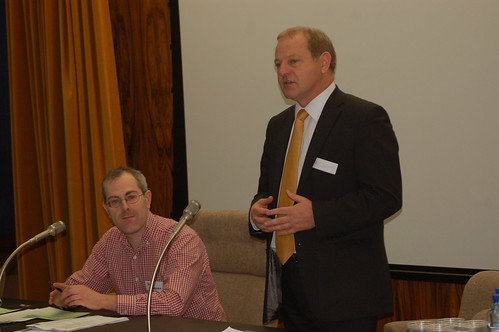
New Redcar MP Ian Swales addresses Conference.
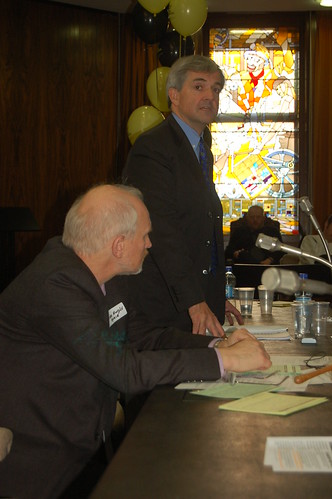
Chris Huhne MP addresses Conference
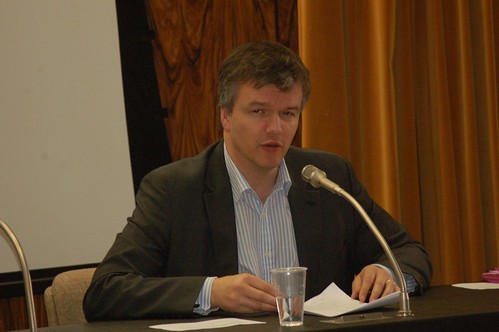
Michael Moore MP addresses Conference
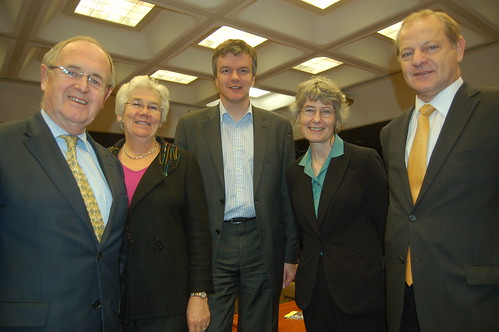
Parliamentarians in attendance: Alan Beith MP, Baroness Maddock, Michael Moore MP, Fiona Hall MEP and Ian Swales MP
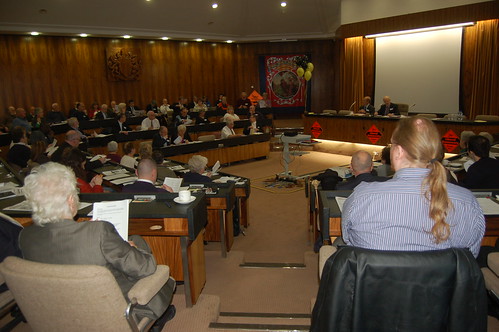
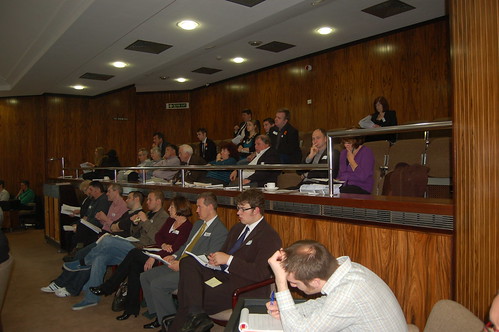
Overflow into the public gallery
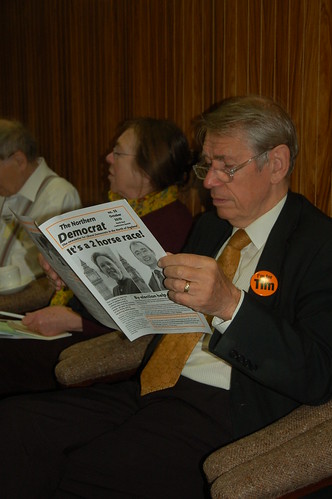
Reading matter: Chris Foote Wood catches up on the latest news via the Conference edition of Northern Democrat, published by, errrr, well me actually!
The Conference was a first for us - we had Cabinet ministers speaking at it! Chris Huhne and Michael Moore to be precise.
New Redcar MP Ian Swales addresses Conference.
Chris Huhne MP addresses Conference
Michael Moore MP addresses Conference
Parliamentarians in attendance: Alan Beith MP, Baroness Maddock, Michael Moore MP, Fiona Hall MEP and Ian Swales MP
Overflow into the public gallery
Reading matter: Chris Foote Wood catches up on the latest news via the Conference edition of Northern Democrat, published by, errrr, well me actually!
Friday, October 29, 2010
Taxing issues on air travel
The outcry from the airline operators about the coming rise in air passenger duty (APD) comes as no surprise. I wouldn't expect anything else. Any sector of the economy will always argue against paying more tax. Yet their complaints overlook the huge tax advantages they currently enjoy.
Air travel is free of VAT. That is a huge advantage in the retail market. Whilst most other goods and services are liable for VAT, air travel comes tax free. APD does not constitute a significantly bigger burden than VAT would, were air tickets to be liable for it.
But this is not the only tax advantage enjoyed by airlines. They pay no fuel duty. This is a long standing advantage that goes back to post war international trade talks. Were fuel duty to be introduced by governments setting their own rate, it would be easy to fly to a country with a low rate to fill up. The effect would be a duty war between countries and almost certainly more pollution as planes fly further to pick up fuel and carry more weight than necessary.
So, two significant tax advantages are enjoyed by an industry whose customers tend to be mainly from the better off. The rise in APD helps to balance out these advantages.
The government is looking into replacing APD with a duty on aircraft. When I worked in the Policy Unit in Cowley St, I worked on aviation policy and I proposed this tax change when I wrote a paper on air travel. The aim is to make air travel more environmentally efficient. Under APD, a full aircraft (and therefore one used more fuel efficiently) pays far more tax than a plane flying half empty. This does not make environmental sense. So hopefully, this tax change will be implemented.
Back to the duty increase coming in next week. One of the arguments put up by opponents of the rise is that it will make holidays in the Caribbean "unaffordable". Are we really meant to cancel the increase because expensive holidays in the Caribbean which are well beyond the means of the overwhelming majority of people will end up costing more for those wealthy enough to afford them in the first place? I think not.
---
Sent via BlackBerry
Thursday, October 28, 2010
Tickets for Take That Clause 4 Comeback Tour arrive in the post
Excellent news from Parliament yesterday over plans to privatise the Royal Mail and to mutualise Post Office Ltd, the franchising body for the branch network, 95% of which is already made up of private businesses. And what an interesting reappearance for Clause 4, last seen when Take That folded in the mid 90s and, just like Take That, now appears to be returning for a Comeback Tour. As with Take That, the old fans are still there, if a little more aged than previously. Vince Cable dubbed them “Heritage Labour”.
Labour MPs are relighting the fire of socialism as they rant against the privatization of Royal Mail. So I thought I would take a look at what the socialist brothers and sisters from my neck of the world have to say. Let’s start with Sharon Hodgson, MP Sunderland. Mrs Hodgson opened up her attack with the claim that, “Reform of the UK’s postal services was in the manifesto of both the Conservative party and the Liberal Democrats.” Then she went on to admit she had read the entire Conservative election manifesto but found no mention of postal services. Sharon, you really do need to get a life! However, it does seem odd that you can make an opening statement in a speech and then go on to trash what you have just said!
Mrs Hodgson wanted to make great play of the fact it was the Liberal Democrats who are committed to the sale of Royal Mail. Labour claim incorrectly that this is a Conservative government pursuing Conservative policies and constantly claim incorrectly that the Lib Dems are there simply to prop up the Conservatives. The reality is that this is a Coalition following an agreed and negotiated programme between the two parties.
Mrs Hodgson demonstrates however that Labour wants it both ways – attacking the Lib Dems for giving too much away to the Conservatives whilst attacking the Conservatives for following Lib Dem policy. As we have seen from her opening statement however, consistency is not her strong point.
And so to Dave Anderson, Labour MP for Blaydon and dubbed “Heritage Labour” by Vince Cable. This came about because of an early intervention by Mr Anderson following a comment by Vince that he was ahead of the Labour party is calling for nationalization of banks at the start of the financial crisis. Mr Anderson intervened: “May I point out to the right hon. Gentleman that for more than a century a number of Labour Members have believed in the nationalisation of the banks?”
Nice try Dave. But consider the following. It was said by Mr Anderson on 12th December 2007 when he vociferously argued against the nationalization of Northern Rock when proposed by Vince Cable:
“It is clear that the Liberal Democrats are starting to bottle out. As usual, they have taken an opportunistic chance to make some hay while the sun shines—that is the way they work, and that is up to them. They talk about nationalisation. I spent my life working in nationalised industries—20 years in coal mines and 16 years in local government. I have a very different ideological view from that of my party's Front Benchers: their view is that public ownership is a good thing and we should have more of it.”
So Dave, supporting nationalization is “bottling out” and “opportunistic”.
Yesterday, Mr Anderson claimed that 6,000 miners will die as a result of privatization of mines in China. And for good measure he attacked the last Conservative government for letting Royal Mail have a holiday from paying pension contributions. Given that this happened with Royal Mail as a publicly owned company, quite how that helps the case of continued public ownership is unclear. If anything, it is a case for privatization. The same point goes for his claims that 200,000 miners were put on the dole in Britain. He simply failed to point out that the huge number of job losses in the industry took place under public, not private, ownership.
Mrs Hodgson and Mr Anderson are not lone voices in the Labour Party singing the old tunes of Clause 4 socialism. Retro Labour does seem to be attempting a comeback tour following the collapse of the Blair/Brown central control. Whilst Ed Miliband may want to reject a swing to the left as making Labour unelectable, that same swing is what so many in Labour’s ranks want to do. I suspect the swingers will get their way. Miliband did after all raise expectations which will now be difficult to control. That was clear from yesterday’s Royal Mail debate.
The only proposal offered by Labour was continued public ownership of Royal Mail. It seems tickets for the Clause 4 Comeback Tour have arrive in the post.
Friday, October 15, 2010
Northern Democrat October 2010
Northern Democrat No 54 Oct 10
This is the latest edition of the Northern Democrat which I edit and produce for members in the North of England.
This is the latest edition of the Northern Democrat which I edit and produce for members in the North of England.
Conference - The Inside Story
This is the video programme I filmed at the Liverpool Lib Dem Conference last month. Presented by me and Greg Stone from Newcastle, we interview 2 Cabinet ministers, lots of members and take a look at the exhibition area and the fringe meetings.
Click on "close to play" at the bottom of the ad to play the video rather than the advert.
Tuesday, October 12, 2010
Taking the biscuit
I had a diary cockup today. Somehow I got my council scrutiny committees mixed up. My diary said it was the "Place" scrutiny committee (ie the one dealing with environment). When I got there, I discovered it was "Healthier Communities" scrutiny committee. As I am not a member of healthier communities I realised then why I had not been sent any papers for the meeting. Anyway, I decided to stay.
On the agenda was an examination of the projects used by employers to help tackle obesity. Though not a committee member, I was allowed to speak. And during my contribution, I suggested that not having a plate of chocolate biscuits and jammy dodgers at the start of council meetings would be good for our own health and set a good example. I suggested that if something had to be served, provide fruit instead.
Alas, I didn't expect my suggestion to be taken up so quickly. By the time I got home, I received an email from an officer which was to the catering section asking for an end to the supply of biscuits to this committee. Rather embarrassing I think - I'm not a member of this committee and I fear its members may now regard me as the Biscuit Snatcher!
The scrutiny committee of which I am a vice chair appears unaffected by this austerity/anti-obesity drive. Perhaps I need to make clear that my suggestion was for all council meetings to make do without biscuits!
---
Sent via BlackBerry
Friday, October 08, 2010
Alan Johnson as Shadow Chancellor
The first announcement of the Shadow Cabinet appointments brings a few surprises. Mr and Mrs Balls are sent to Home and Foreign Offices respectively. Of more interest is the appointment of Alan Johnson as Shadow Chancellor. Of all the current Opposition front bench he is the one for whom I have most time. Nevertheless, quite how he fits into the "new generation" is not clear.
---
Sent via BlackBerry
---
Sent via BlackBerry
Thursday, October 07, 2010
Nick Clegg speech to Conference - the video
The next video from Lib Dem Conference is now edited. This is it: Nick Clegg's speech as Leader and Deputy Prime Minister.
No great surprises in the Pensions Review
The interim report published today by John Hutton into public sector pensions has produced no surprises. It reveals what we already know: we are living longer, current provision is unaffordable in the long run and those in the public sector pension scheme will have to pay more into it and work longer. The proposal to end the final salary scheme was well trailed under the last government. So again, no surprises.
The biggest problem with final salary schemes is that they were invented decades ago for a different era. Then, career mobility was much less than it is now and people would live only a few years into retirement. Schemes relied less on public funds to top up pension payments when the funds themselves were insufficient.
Times however have changed. Increased longevity in particular has put incredible strain on final salary schemes in the public sector. The private sector has recognised that for some time. That's why most private final salary schemes have been closed to new entrants. Many companies have switched to money purchase pension schemes. This is not what is proposed by Hutton for the public sector.
What Hutton has called for is the replacement of final salary schemes with what is an average career salary scheme. There is a strong fairness argument for making this switch. Those at the top end of the salary scale in the public sector who have risen in the ranks in previous years have not paid across their working life the contributions that reflect the final salary pension to which they are currently entitled. That is far less the case for people at the lower end of the salary range in the public sector.
The result of this anomaly is that lower paid public sector workers and the taxpayer generally subsidise the pensions of well paid public sector bosses. This is hardly fair on lower paid public sector workers generally or on the private sector workers who may not be in a pension scheme but whose taxes pay the pensions of those earning vastly more than they do.
So generally, the Hutton proposals at least need serious consideration. Unfortunately, all we have had from Unison is a kneejerk reaction with hints of strike action.
---
Sent via BlackBerry
Wednesday, October 06, 2010
Speeches from the "Yes" rally at Lib Dem conference
A couple more videos from Lib Dem conference are now ready and on YouTube. These were shot at the pro-AV rally. The first is of actor Art Malik, the 2nd of Nick Clegg.
Tuesday, October 05, 2010
One look at the weather forecast and I went nuts
I left London this morning to return to Gateshead. On arriving back home I caught the weather forecast. Not good news tomorrow. Rain, rain and more rain. I had planned to go to local woodland to pick wild hazel in the morning. The wild food foragers amongst you will know that hazel is something of a wonder food - high in protein, essential oils and vitamins. Picking them in heavy rain however is not something that greatly appeals to me.
So having dropped off my camera equipment back home, I headed off to Lotties Wood and spend an hour picking hazel. I got about 2kg before I had to return home to get ready to go to the Sunniside History Society meeting. Next September I am the person doing the talk to the Society. I'll be speaking on wartime rationing and recipes. I'm doing some work on this at the moment. I now know I have 11 months to complete the research and write the script. Hazel nuts will make an appearance in this talk!
Tonight's talk was about shipbuilding on the Tyne in the First World War. This was of some interest to me. For my PhD I wrote the biography of Walter Runciman who was President of the Board of Trade during the first two years of the First World War. That meant he was responsible for shipping. He also came from a family of shipping owners from Tyneside. So tonight was clearly of interest to me.
Monday, October 04, 2010
Why should millionaires get child benefit?
Making cuts is a difficult and often unwelcome activity, but when you are running out of money and spending vastly more than you are earning, cuts are necessary. When making cuts, the chief targets should be to stop spending on things that are not necessary. Targetting benefits of the wealthy is therefore necessary in times of austerity. When cash is short, giving child benefit to those earning enough to pay the higher rate of tax needs to be reconsidered. Whilst only a few higher rate taxpayer are millionaires, compared to the rest of the nation they are comfortable. And if you are fortunate enough to be earning enough to pay the 50p rate, receiving cash benefits other than the state pension is not very defensible.
The financial situation requires some difficult choices to be made. If the decision today to end child benefit in 2013 for higher rate taxpayers is not taken, alternative savings will have to be found. That could be done by cutting benefits of those who genuinely need them. That's simply not an acceptable choice. It could be done by raising taxes further on the wealthy. But what purpose would it serve to tax the wealthy more just so they can be given the money back as benefits? It could be done by raising taxes generally but who would be stupid enough to put up taxes on people on low incomes to pay for benefits for the wealthy? Or it could be done by borrowing more. The result of that however would be cuts down the line to services as we would still need to pay back anything borrowed, with interest.
So, there are alternatives but they each have consequences. Which one Labour follows is difficult to work out. All I have heard today from Labour is Liam Byrne (he of There's-no-money-left fame) who has attacked the plan to end child benefit to the wealthy.
So, if Labour are to continue to oppose this cut, they should at least have the decency to explain how they would pay for these cash handouts to the better off and the rich.
---
Sent via BlackBerry
Simon Hughes MP - speech to Conference
I am gradually editing the videos filmed at Lib Dem conference last month. This is the speech of the Deputy Leader Simon Hughes MP.
Sunday, October 03, 2010
Cuba and the deficit story
Cuba is one of the few remaining communist countries left. It survived the collapse of communism 20 years ago. Whilst most countries sent socialism packing, Cuba clung to it, though at an enormous cost to its economy and standard of living. I visited the country 4 years ago and saw at first hand how threadbare and rundown everything is.
Now I see that under the leadership of Raul Castro, Fidel's brother who recently took over the reins of power, Communist Cuba is to shift towards capitalism in an attempt to cut the ballooning government deficit. By April next year, the state payrole will be cut by half a million people. Self-employment is to be legalised in a large number of trades.
I wonder what the Labour party in the UK thinks of that. They continue to argue for massive borrowing to maintain revenue expenditure. The rest of the world is moving to balance budgets. The Left, when it is in power, recognises that economic and financial reality cannot be ignored. The real world kicks in.
It is an interesting point that socialist governments the world over are bringing in austerity drives. It's not just Cuba. Spain has a socialist government. And austerity measures there are far greater than anything planned for the UK. Perhaps the UK Labour Party should look abroad to their "comrades" for a lesson in economics and finances.
---
Sent via BlackBerry
Saturday, October 02, 2010
The Wi-Fi arriving at platform 1 is not free
I got a message from East Coast Trains through the week telling me that their free wi-fi service is no longer to be free. Had the service they inherited from National Express been any good, the decision to charge would have been understandable. The problem was, the wi-fi was at best intermittent. The rest of the time it was just plain frustrating. I often tried to use it and ended up plugging in my dongle and accessing my commercially provided service.
So, here's to hoping that East Coast Trains ensure a greatly improved service will be available to paying customers (which doesn't block channels such as YouTube). For those lucky people travelling first class, the service will continue to be free. For the rest of us plebs, we get 15 minutes free and then the bill kicks in. My experience is that it can take 15 minutes to download a single page.
I can appreciate the need to raise revenue and as a regulated train operator, there are controls on the level of fares. But I have a niggling doubt about all this. Is it the start of a shift towards pricing structures similar to budget airlines. Will there be hidden costs coming down the line such as baggage costs and a charge to spend a penny? I hope not, but we may need to watch carefully what comes our way.
---
Sent via BlackBerry
Scary, but not scary enough
I blogged last night about going to see a play called Ghost Stories. Well, I went, I enjoyed and I saw it through to the end. And yes it was scarey. But, for me, it wasn't quite scarey enough. I can't tell you what happens at the end however. We are all sworn to secrecy. But if you get the chance, go and see it. And be prepared to jump out of your seat.....
---
Sent via BlackBerry
---
Sent via BlackBerry
Ed Balls - the worst history lecturer in history
Anyone see the speech by Ed Balls to the Labour Conference? It strikes me that if anyone wants to delve into history to lecture us about historical precedents and the "lessons of history", they should at least get their historical facts right.
Mr Balls claimed:
And the previous Prime Minister to say ‘there is no alternative,' was a Labour Prime Minister, Ramsay MacDonald, in 1931, two years after the 1929 Wall Street crash - the second biggest financial crisis of the last hundred years.
There is no alternative, MacDonald said, but to cut spending and unemployment benefits to get the deficit down and keep the financial markets happy.
But this party said No – and so did Lloyd George and the Liberals.
And MacDonald had to form a Coalition with the Conservatives to make his cuts.
And what happened?
The Great Depression of the 1930s, mass unemployment and – yes – the deficit got worse.
Conference
You either learn the lessons of history or you repeat the mistakes of history – and that’s what they are doing.
Just think if Clement Attlee in 1945 – when after the war when our national debt was over twice its current level – had said that the first priority was to get the deficit down…there would have been no NHS, no new homes for heroes and no welfare state.
But we don’t need to go back to the history books to see the warning signs over George Osborne’s economic policy - we only need to look across the Irish Sea.
So let's take a look at the History of the World According to Ed Balls.
"There is no alternative, MacDonald said, but to cut spending and unemployment benefits to get the deficit down and keep the financial markets happy." - The question has to be asked, why did the Labour Cabinet in 1931 consider and agree to massive cuts? The Labour Government in 1931 was ready to make cuts to close the deficit. They fell apart because a small majority of Cabinet members could not go the full distance - they agreed to 90% of the cuts but baulked at the proposal to cut unemployment benefits. Balls was simply wrong to suggest Labour opposed cuts in 1931 (just as Labour are historically wrong to say they did not bring in cuts before they left office in 2010.)
Balls went on to claim, "But this [Labour] party said No [to forming a Coalition] – and so did Lloyd George and the Liberals." Utterly wrong. The Liberals formed a Coalition with the Conservatives. That's why it became a National Government and it is what gave the administration a majority in the Commons before the 1931 general election. It is true to say that Lloyd George stayed in opposition. He was joined by only 4 other Liberal MPs, one of whom was his daughter Megan, and another was his son Gwilym. The other 2 were close allies of Lloyd George. The rest of the MPs, nearly 60 in total, supported the National Government.
And to imply that Ramsay MacDonald was alone in the Labour Party in entering the National Government is simply historical rubbish. Philip Snowden, the Labour Chancellor, continued in his post in the National Government. Admittedly, the number of MPs who backed the National Government was small - 11 in total. But that is 10 more than MacDonald by himself.
Balls then claimed, "And what happened? The Great Depression of the 1930s, mass unemployment and – yes – the deficit got worse." This is an interesting interpretation of history. Unemployment did continue to rise but not as a result of the formation of the National Government. The depression started in 1929 and unemployment had already risen dramatically before the National Government was formed. Typically, Balls overlooked this. No doubt in years to come he will be claiming that unemployment did not happen until the Coalition was formed in May 2010.
Finally, Balls claimed, "Just think if Clement Attlee in 1945 – when after the war when our national debt was over twice its current level – had said that the first priority was to get the deficit down…there would have been no NHS, no new homes for heroes and no welfare state." This is becoming part of the stock of Labour's claims against the Coalition - 1940s history has been rewritten to suggest that Britain had massive debts but could afford to spend vast sums of money to create the welfare state and the NHS. The implication is that you can keep on spending without taking any austerity measures.
This is of course total rubbish. Labour introduced austerity measures which make what we are about to face pale into insignificance. The postwar years of the late 1940 are not known as the Austerity Britain for nothing. This was a period in which Labour introduced even more controls than were place in the war years to cut consumption, reduce the public sector deficit and get British industry exporting to earn desperately needed foreign currency (especially dollars). Rationing to cut domestic demand was even extended to foods that had escaped rationing during the war, for example, bread.
It is rather worrying to think that Ed Balls was in charge of the country's education system up to May 2010. Let's hope he never had any input into the history elements of the National Curriculum. He potentially could have turned the country into a nation of history dunces.
If anyone is interested, I wrote the biography of a National Liberal Cabinet Minister, Walter Runciman, for my PhD thesis. Hence my interest in the history of the 1930s. And I am currently doing research on British food rationing in the 1940s. I hope to have that completed next year.
Photos from Conference
At last, I've got round to sorting all the photos from Conference. A selection is now on Flickr. You can see them at www.flickr.com/photos/jonathanwallace. I sent out the link to 700 people on my email list yesterday with the result that there were 500 visits to the site yesterday. The photos can be used in Lib Dem literature.
I've included a few of my favourites below.
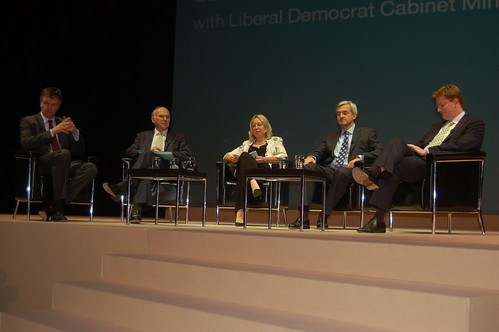
The Cabinet Q&A on the last day of Conference and one of the last photos I took before leaving Liverpool.

Nick Harvey MP, Armed Forces Minister, welcomes the Lib Dem call to put Trident into the Defence Review.

Daniel from Durham is interviewed by BBC North East at the Northern Night reception.
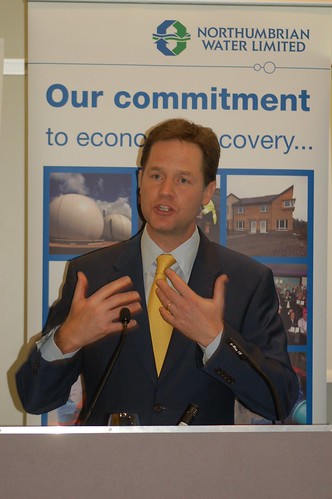
Nick Clegg speaking at the Northern Night reception

North East Lib Dems launch the "Yes" vote campaign for the AV referendum.

Nick Clegg's speech.
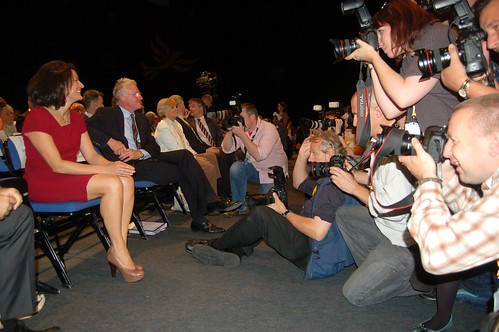
Miriam Clegg takes her seat for Nick's speech and is greeted by a scrum of photographers (me included).
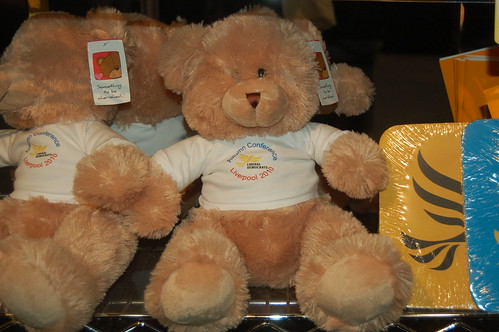
In an attempt to boost membership even more, Teddy Bear's are now allowed to join!
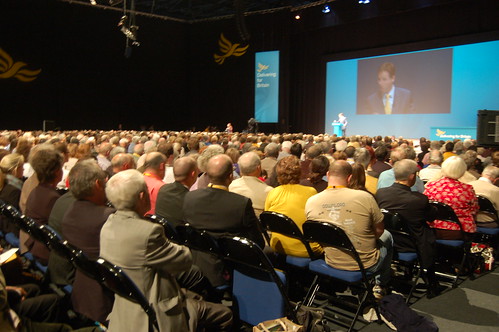
Conference listens to Nick speak.
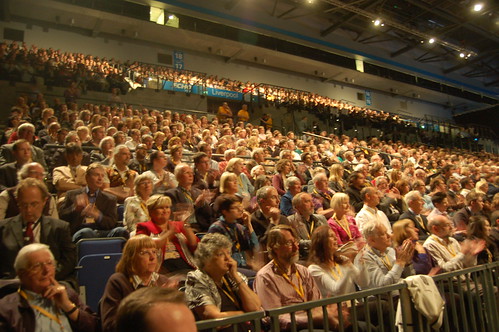
Conference continues to listen to Nick speak.
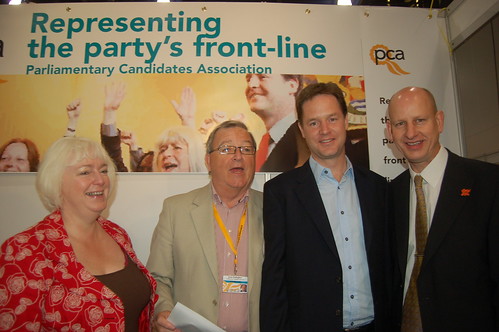
Nick visits the Parliamentary Candidates Association stand in the exhibition tour.
I've included a few of my favourites below.
The Cabinet Q&A on the last day of Conference and one of the last photos I took before leaving Liverpool.
Nick Harvey MP, Armed Forces Minister, welcomes the Lib Dem call to put Trident into the Defence Review.
Daniel from Durham is interviewed by BBC North East at the Northern Night reception.
Nick Clegg speaking at the Northern Night reception
North East Lib Dems launch the "Yes" vote campaign for the AV referendum.
Nick Clegg's speech.
Miriam Clegg takes her seat for Nick's speech and is greeted by a scrum of photographers (me included).
In an attempt to boost membership even more, Teddy Bear's are now allowed to join!
Conference listens to Nick speak.
Conference continues to listen to Nick speak.
Nick visits the Parliamentary Candidates Association stand in the exhibition tour.
Friday, October 01, 2010
Rain stops play (or at least it stops me filming)
I was supposed to do some filming today. I had been booked in to shoot some video at 3pm in London. Alas, the weather was vile. We have rescheduled it to another day. Instead, I spent time working on members' newsletters. Tonight I am off to see a play called Ghost Stories. Apparently it's had rave reviews. I shall report on it sometime this weekend.
---
Sent via BlackBerry
---
Sent via BlackBerry
Labour's Irish example turns sour
In the battle for hearts and minds over the deficit and cuts, Labour have employed Ireland as evidence to support their anti-cuts position. Their argument is that spending must continue and that borrowing should be maintained to cover the gap between revenue and outgoings. The events in Ireland yesterday show what happens when that argument holds sway.
Another bank bailout in Ireland took place because the banks borrowed more than they were capable of paying back. And that is the story of the Irish economy. The Irish Tiger turned out to be a useless fat cat supported by credit that ran out. There was no economic miracle, just a great deal of debt. Every time money is borrowed, it has to be paid back at some point.
Labour argues that spending should be maintained by borrowing. Look across the Irish Sea to see the end result of such a policy. Bankruptcy, unemployment, business closures and recession are the price ro pay when the debts come home to roost. That's the future offered by Labour.
---
Sent via BlackBerry
Thursday, September 30, 2010
If only everything in life was as reliable as a Volkswagen
Three hours on a train and there's plenty of time to catch up on some of those little jobs that have been shelved for the past couple of weeks due to conference. I was hoping to get more posts up during the week but the great thing about great plans is that they never go to plan.
Anyway, my most embarrassing moment of the week was on Tuesday evening. We have just bought my mother's VW Golf. Tuesday evening was meant to be the first time I would drive it in the evening. Headlights are a must. I was due at a meeting at 7pm. It was 6.45 and I got in the car. Ten minutes later I was still outside the house trying to work out where the switch for the headlights was. After struggling with every lever and dial I could find, resulting in an interesting display of flashing lights which must have entertained the neighbours, I ended up phoning Mam. (David who is normally first port of call for anything complicated such as switching on a light or recording a tv programme was at a meeting so I lacked my normal solution to technical problems.) It turned out the dial I needed was right in front of me. I simply thought it was the dial for opening the air vents!
The best At-Last-We-Have-A-Use-For-Jonathan moment was also on Tuesday evening. I go nowhere without a camera. So when I turned up at the Council's Whickham garden awards, I found myself in the role of photographer. The photos went on to a disc yesterday and I took them into the Civic Centre to give to the officer only to forget completely to hand them over. My thanks go to Cllr John Hamilton who was at the Tyne and Wear Museums Ctte with me this morning. He kindly took the disc and has hopefully handed it on.
Most-Useful-Piece-of-Information-Overlooked-By-Jonathan moment was also this morning. I am doing some research on the Washingwell Roman Fort near Whickham. And I discovered this morning at the museums committee that there has been an exhibition about the early Roman occupation of the North, pre-Hadrian's Wall, in the Segedunum Musem in Wallsend. This is the period from which Washingwell dates. And the date for the end of this exhibition? This weekend. Not very helpful as I am on a train to London and won't be back til Tuesday! I understand it will be transferred to Carlisle. I feel a trip to Cumbria coming on.
---
Sent via BlackBerry
Miliband's departure could be the big break for Balls
The departure of David Miliband leaves politics generally the poorer. It also leaves the Labour party with a hole at the centre. DM may not have taken up a position that I would agree with every time he made it, but he was a centrist politician who understood the importance of remaining in the centre ground. As I said on Friday, his election as Labour leader at least would mark a recognition that Labour must remain in the centre ground if they are to return to office within the next decade. The election of Ed Miliband would mark instead a shift to the margins and a move away from power. ED won, and the long march begins.
The departure of DM however opens up the door to Ed Balls. His speech yesterday was clearly a pitch for the post of Shadow Chancellor. Balls is a bruiser and would relish the prospect of leading an anti-cuts campaign. His views reflect much of what Labour delegates were claiming. Whilst Darling and even Ed Miliband warn that not all cuts should be opposed, Labour members will not follow that line. Their mood is to oppose every cuts. ED's election has opened the floodgates of oppositionism and were Balls to be appointed Shadow Chancellor, it will mean Labour are following a populist, irresponsible line that will blow to pieces the years of hard work in the 1990s that gave Labour the image of a responsible party capable of taking difficult decisions when it comes to the economy and tax.
If ED is true to his word in his Leader speech about being responsible and supporting some cuts, he will not make Balls his Shadow Chancellor. If he is a populist with not answers to the biggest issue of the day, Balls will get the appointment he wants.
---
Sent via BlackBerry
Off to London
I am currently heading down to London on the train for a few days. I've been asked to do some photos and video for someone. As usual, I choose the days of travel with impeccable bad timing. Having had loads of rain through the week which stopped me from getting out to pick various crops, today is sunny and warm, ideal fruit picking weather. I just hope the fruit survives until I'm back next week. David is holding the fort back home so should be able to get in some crops from the allotment. But the wild foods, especially blackberries, are early this year and have slightly caught me by surprise.
Meanwhile, whilst at Tyne and Wear Committee in Sunderland this morning, I discovered another councillor in Gateshead who keeps chickens. I feel there may be a bit of self-sufficiency trading going on: marmalade for eggs!
Talking of self-sufficiency, one drawback of going to London is that I have to survive on bought food. The more self-sufficient we become at home, the less I like the food available in shops. Commercially produced bread in particular is rubbish. I've eaten better cardboard! Despite this, I'm aiming to do some work on wild foods growing in urban areas whilst in London. If anyone is interested, you can follow this on my other blog www.self-sufficientinsuburbia.blogspot.com.
---
Sent via BlackBerry
Monday, September 27, 2010
Tiny turnouts in the Miliband race
If I were David Miliband, I would be hopping mad about the byzantine electoral college that gave his brother the Leadership despite the latter being rejected by the members and MPs. I blogged a couple of weeks ago about the tricks used by the GMB to ensure the bosses got an endorsement for their candidate. This included sending out the ballot papers in Ed Miliband envelopes which urged members to back the GMB candidate.
The result of this sort of Putin style electioneering was that EM was so well ahead in the union section that he could overturn the votes of the members and MPs.
But matters do not stop there. I have just looked at the turnouts in the trade union section. The GMB issued 554,130 ballot papers (complete with their pro EM literature). Turnout was a mere 7.8%. This was a contest that failed completely to catch on with trade union members. Only 18,182 members actually gave their first preference to EM. There were 6,352 members of the GMB who spoilt their ballot papers rather than take part in this charade of an election. That was more than voted for each of the three non-Milibands.
The GMB was not the only union that backed EM and got a derisory turnout. Unison came in at an even worse 6.7%. Unite on the other hand at least managed to get into double figures, scoring a whopping 10.5%.
These tiny minorities, under the heavy influence of their union masters, have been able to impose their candidate against the wishes of the Labour members and MPs. Democray in the Labour party? My a*se.
---
Sent via BlackBerry
Is that it?
I've just listened to Alisdair Darling's speech to the Labour Conference. A long defence of what he did in Government. Fair enough. An attack on the Tories in the last Parliament for failing to come up with any solutions to the banking crisis two years ago. Fair enough. That of course is all history. Where was the content about the future, about the way forward? Apart from a quibble with the Coalition about eliminating the deficit quicker than Labour, there was nothing said about what Labour should be doing other than "staying in the centre ground."
"Is that it?" I asked myself. Seems as though it is. No answer to the greatest issue of the day.
---
Sent via BlackBerry
Union boss highlights the Labour dilemma
Ed Miliband stated yesterday that Labour will not oppose every cut. Quite which cuts he will not oppose are not explained but it is at least an attempt to be credible on the deficit. Miliband's attempt to reposition himself away from all the claims of opposition to cuts he made during the Leadership election however were instantly torpedoed by Ken McCluskey, deputy boss of Unite. This morning, in a BBC News interview, he said there was no need for any cuts at all.
And there lies the dilemma for Labour. Do they oppose cuts and get the short term benefit that will accrue, complete with a general feeling of comradely warmth that individual Labour members will experience by taking an unrealistic posture? Or do they take a more level headed approach that acknowledges cuts are needed, therefore appearing credible to the electorate but risking alienating a significant proportion of Labour members and trade union bosses?
It will be interesting to see how this debate proceeds but on Friday last week I argued that the election of Ed Miliband will be seen as a green light by many in the Labour movement for a march to the unrealistic fringe, even if EM realises that credibility with voters requires backing some cuts. What we had today with McCluskey is only the start of that debate, and I suspect it is a debate that will tie up Labour for some time to come.
---
Sent via BlackBerry
Sunday, September 26, 2010
Lib Dem Blogger of the Year Awards - the video
This is the first of my Conference videos and probably the one of most interest to fellow Lib Dem bloggers - the Lib Dem Blogger of the Year Awards. Alas, everyone somehow forgot to nominate me for anything! Undeterred, I still turned up with the camera to film the event.
Saturday, September 25, 2010
The Geek has got it
I never thought the Labour party could be so interesting! So the Geek has got it. Ed Miliband was rejected by the MPs and the Labour members, but has been foisted on the Labour party by the Trade Union vote. Labour wanted to go in the direction of electability. The trade unions wanted to go back to the 1980s. They have won. Labour have lost.
---
Sent via BlackBerry
---
Sent via BlackBerry
Friday, September 24, 2010
The Labour leadership
With less than a day to go to the declaration of the Labour leadership result, I thought it would be worth delving into the what the outcome could mean. I don't think there is a need to waste our time on the non-Milibands as the consensus from all sides is that Abbott, Balls and Burnham are out of the running.
So firstly, David Miliband (DM). He was clearly the front runner in the eyes of the Westminster media pack 3 months ago though I have previously pointed out that there was no evidence to back up this DM winning prediction. I suspect the Westminster journos were making predictions based on their knowledge of MPs in the Commons hothouse. They lack however any significant knowledge and often understanding of grassroots politics. As the Labour Parliamentary Party was mainly built up under Blair, then it is likely that a Blairite candidate would have more pull with the MPs. There could be a bit of a gulf between the MPs and the rest of the Labour party if DM is elected.
So will the election of DM the Blairite (despite attempts to distance himself from his former Leader) mark a continuation of a New Labour outlook within the Labour Party? My suspicion is that it will only be a partial readoption of what won Labour three elections. The genie is rather out of the bottle with Labour and my reading of the situation is that most Labour members are wanting to head back to the comfort zone of opposition and the sort of policies that lost them elections in the Thatcher years. DM will experience some difficulties in moving his party in the direction needed to win an election.
Nevertheless, DM as Leader at least implies a recognition by Labour that electability is important. And he has so far avoided the more extreme attacks on the Lib Dems whilst his fellow contenders, especially his brother, have engaged in a battle to be the most beastly to the Lib Dems. This is not just an interesting debating point. At the next election in 2015 the two most likely outcomes are a Conservative majority or no overall control. The chances of a Labour majority are slim. If Labour wish to return to office in 2015, they have to be open to coalition with the Lib Dems. DM offers Labour the best opportunity to do that.
That cannot be said of Ed Miliband (EM). He has clearly positioned himself as a candidate with left-leaning credentials. Whether or not he genuinely wants to take Labour in a more traditional left wing direction is not clear. I suspect he has agreed to carry the baggage of the old Labour supporters he has courted, even though he may not necessarily believe it is credible to rebuild Labour on such thin foundations. Nevertheless, EM has built up a massive head of steam behind a shift to the left and expectations will need to be satisfied. EM will have great difficulty stopping a full scale charge to the left by the Labour grassroots.
EM has also whipped up a fervour against the Lib Dems which will also make future coalition discussions extremely difficult. In effect, the choice of EM is tantamount to a declaration that Labour will reject coalition after the general election even though it is their only realistic route back to power within the next decade. The choice of EM has a wider impact on politics. It narrows down needlessly the likely choices before the British people of the political make up of the government in 2015: majority Conservative or Con Lib Dem coalition. It removes the option of a Lab Lib Dem coalition. Whilst I have serious differences with Labour, the people should at least have the option of choosing such a government in 2015.
The final point I make about the Labour Leadership is that DM is much more positive about getting a yes vote in the AV referendum. EM seems uninterested. He is also beholden to the likes of the GMB who are against reform. It will be much more difficult to win the referendum without the active support of the Labour party leader. It could be therefore that if Labour elects Ed Miliband they will be opting for a decade in opposition and wreck voting reform that could lock them out of power for an even longer period.
---
Sent via BlackBerry
The banks are squealing
The publication today of the Commission into Banking's report on the issues they will consider has not come a moment too soon. They have a year to come up with their proposals to reform the banking system. I am looking forward to what they come up with. As a supporter of liberal economics, for capitalism to work properly, competition is needed. When markets are dominated by a small number of giant operators, competition is reduced, service deteriorates and costs to customers go up. Monopoly is bad for markets and needs to be stopped from developing. I covered all this when I worked in the Lib Dem Policy Unit earlier in the last decade when I wrote our policy paper on competition and business.
So, hopefully the Commission will recommend a break up of the big banks, especially the Lloyds Group, the creation of which was a poisonous legacy of the last Labour government.
What we have heard today however is the squealing of the top brass in the banking sector. Stephen Lester, brought in to head Royal Bank of Scotland after its near collapse, calls the inquiry a "red herring". He is of course top cat in a business that is now 83% owned by the taxpayer. His business is therefore a direct beneficiary of the unintended blackmailable situation of being too big to fail. So, I really think he should not be expressing such comments from such a privileged position.
---
Sent via BlackBerry
Wednesday, September 22, 2010
When the going gets tough, the defectors get going
It is always disappointing to learn of a defection from the Lib Dems just as it is pleasing to learn of defections to us. Alas, I have to give you the disappointing news. Yvonne McNicol, councillor for the neighbouring ward to mine, has jumped ship to sit as a Labour councillor. It's a pity she never at any point raised concerns with us. I had counted her as a friend and as someone who worked incredibly hard to get her elected and re-elected, I am deeply upset she chose not to speak to me about what she was going to do. I learnt of her defection yesterday when the Journal phoned me.
Yvonne is due for re-election next year but this year, Labour won the seat that was up for election in the ward. She was facing an uphill struggle to hold on though I would have done everything possible to ensure she would have won as the defending Lib Dem councillor. Yvonne would have had to work hard to hold on but I have lots of memories of her saying to me that putting out Focus leaflets was often difficult for her in terms of her own time.
I am not going to question her motives but her explanation that she is unhappy with the cuts and the coalition takes some swallowing given she has not raised any concerns with us despite many opportunities to do so.
The claim that she is against government cuts is all the more baffling. She is joining the Labour group that cut millions from Gateshead's services in March, nearly two months before the Coalition was formed. She is also joining a party that closed her local library and post office. Her claim that Coalition policies are damaging Gateshead is remarkable given she is joining a party that increased the wealth divide between rich and poor and doubled unemployment. And suggesting that restoring the pensions link and taking thousands of low paid Gateshead residents out of tax do not strike me as damaging to the borough.
But Yvonne has made her decision. Whatever the motive, she has left us. I am disappointed with that, and given that I have worked so hard in her ward for her, I am quite upset. She asks that her decision be respected. Okay, we will do that but I say to you Yvonne that you must respect you former colleagues who worked so hard to get you where you are now and who you have now left. You have joined a party that I find is often disrespectful to me. I hope you are not going to join in the treatment that I have endured from your new party. Respect, Yvonne, is needed on both sides.
Government is not comfortable, nor should it be. Decisions should be justified. Opposition is comfortable because it does not require you to justify decisions that have been taken. That's not to say that opposition always behaves in such a way, but at the moment, Labour are behaving in a very irresponsible way. After years of great discomfort, Labour have entered the comfort zone of opposition.
I guess a small number of those who join parties of whatever colour in their good times in opposition end up finding the move from the opposition comfort zone to be too uncomfortable. When the going gets tough, the defectors get going - back to the comfort zone.
---
Sent via BlackBerry
Conference ends
This is the first opportunity I have had to get a post written since I was on my way to conference on Saturday. I am now back on the train, waiting to leave Liverpool and head home.
I predicted previously that the media would report on a different conference to our own despite journalists attending in record numbers. What news coverage I saw suggests the party was in uproar over the coalition. My experience is that the vast majority of members attending conference were pleased with the fact we are now in government. That's not to say all members like the Coalition, but more about that on a different post.
Two significant physical features jumped out immediately as marking a change with the past. It was vastly bigger than any previous Lib Dem conference. And on arrival, I felt like I was coming into an airport terminal - security officers and scanning machines everywhere. I have been an observer at both Tory and Labour conferences in the past so I have experienced the same sort of security at conferences already. Nevertheless, it is a rather sad reflection on the state of where the country and national security is when party political conferences are under such a state of siege.
That said, where were the armies of protesting trade unionists? Saturday saw what could only be described as school leavers wearing Unite trade union jackets ranting at us, in rather middle class tones, as we went through the main gates that "You are all Tories." As far as being constructive, persuasive debate, it wasn't. They were rather small in numbers and no one was taking much of an interest in them. They may have felt a warm glow in themselves as they had had a good shout at Lib Dems, but they achieved absolutely nothing other than to become the butt of a few conference jokes. I was tempted to ask them whether they planned to wreck anyone else's holiday (Unite is of course the union that has brought out the BA workers) but then decided I couldn't be bothered and went for a cup of tea instead.
The only other protesters we saw were a handful of Communications Workers Union members handing out leaflets opposing plans to save the Royal Mail from collapse. Their demonstration was disappointingly tiny.
My time at conference was spent mainly on taking photos and video. I have somewhere in the region of 2000 pics and 6 hours of tape to sort. Greg Stone from Newcastle, and I have filmed a video programme for members about conference. It will take some time before it's all edited but it should be on YouTube soon. We have interviews with Vince Cable and Chris Huhne as well as a number of ordinary members.
So, end of conference and I am now heading home to catch up with sleep and the rest of my life.
---
Sent via BlackBerry
Saturday, September 18, 2010
Off to conference
It was all planned in detail. I would take our car to conference. It would be its last journey. It is being replaced and is heading for the second hand rust market. However, I hate driving and have not driven any long distance for over a decade. So this morning, I woke up and decided I couldn't face the prospect of driving all the way to Liverpool. The detailed route I had drawn up to get there was scrapped. David gave me a lift to Newcastle Central and I am now on the train, complete with suitcase, laptop and what appears to be a mobile (and rather heavy) studio of cameras.
So, last week was TUC conference, held in La La Land, with Back To The Future style debates on general strikes and "co-ordinated action" against any plans to restore the economy and cut the deficit. Clearly the "comrades" were enjoying a retro 1980s revival.
Meanwhile our conference will be attended by an army of journalists who will undoubtedly leave us with a feeling that they were there but were reporting on a completely different gathering. Anyway, I will be doing lots of filming at Liverpool. And I am putting on 3 photo ops as well, one of which is this afternoon. Hopefully I'll get there on time!
---
Sent via BlackBerry
Friday, September 17, 2010
A dodgy election ploy to help Ed Miliband win
I discovered what at best can be described as a dodgy election ploy and at worst as little better than a Mugabe style voting tactic when I returned from holiday earlier this week. Let me explain....
The Trade Unions have made no secret of their desire to see Ed Miliband as the new Labour leader. They see him as a more leftwing character, more in tune with the wishes of the union barons (trade union members may have a different view on matters). And most importantly for the likes of Kenny, Prentice and co, Red Ed as he was dubbed by the Sun this morning, is the candidate who could beat David Miliband, the Blairite who was fast tracked to Cabinet by his chum and now Labour hate figure, Tony Blair. Who the trade unions back, as corporate organisations, is their affair. How they arrive at that decision is their own affair. But there is a difference between what the corporate view of an organisation is, and that of individual members. This is why the trade unions moved to a system of individual members who pay the political levy being able to vote in such matters as the Labour leadership contests. Even Labour saw that the union block vote being wielded by trade union barons to choose the Labour leader was a public relations disaster. But old habits die hard. Look at the following.
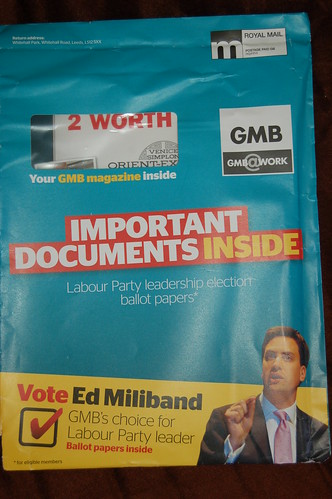
This is the envelope in which the Labour leadership ballot papers were sent to GMB members. I was so staggered by what I saw that I felt the need to photograph it and share this Mugabe style election tactic with the rest of the world. Whilst I think it is reasonable for an organisation to have a corporate view on an issue of who the Labour leader is, for the same organisation then to send out the ballot papers in envelopes emblazoned with publicity for one candidate must surely amount to official sanctioning of an inbuilt advantage for the campaign of the person the union bosses are backing.
In other words, this is an abuse of democracy. It's the sort of thing you would expect to see in Putin's Russia where the media was controlled by Putin's backers and opposition was virtually excluded from the airwaves during election periods. But it wasn't just the envelope. Below is the letter that it contained from Paul Kenny, big chief of the GMB.

As you can see, over half of it is a eulogy to Ed Miliband. Granted, it does also direct voters to pages 14-15 of the magazine that came with the ballot papers if people wanted to read more about the views of the 5 candidates. Here's the magazine:
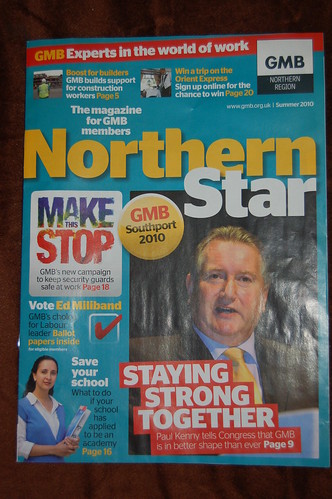
Note that Miliband Junior is endorsed on the front page. "Vote Ed Miliband, GMB's choice for Labour leader" - which could lead some people to think that as GMB members they are required to vote for Red Ed.
Does the GMB, on pages 14-15 give each candidate equal billing? Have a look:
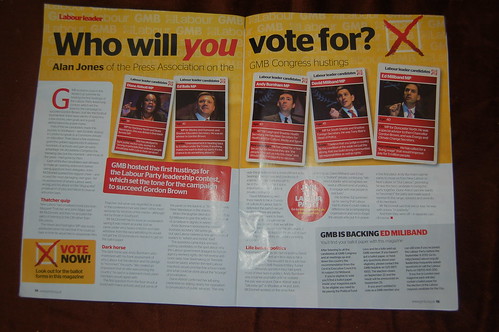
The answer is no. The pages had the minimum of space for the views of the candidates (in that respect they were all treated equally), the accompanying article had more about John McConnell who failed to get nominated, but the page carries a clear article that the GMB corporately are backing Ed Miliband.
It strikes me as bizarre that the trade unions can get away with this sort of undemocratic activity. Surely the Labour party must have rules that ensure fairness in their own internal voting systems that prevents what most of us would regard as a distortion of democracy. But it also raises a more troubling issue. Assuming Labour want to return to power at some point, they will be in the pockets of a small number of individuals who have no problem with engaging in the sort of activity that contaminates democracy and pollutes politics.
The Trade Unions have made no secret of their desire to see Ed Miliband as the new Labour leader. They see him as a more leftwing character, more in tune with the wishes of the union barons (trade union members may have a different view on matters). And most importantly for the likes of Kenny, Prentice and co, Red Ed as he was dubbed by the Sun this morning, is the candidate who could beat David Miliband, the Blairite who was fast tracked to Cabinet by his chum and now Labour hate figure, Tony Blair. Who the trade unions back, as corporate organisations, is their affair. How they arrive at that decision is their own affair. But there is a difference between what the corporate view of an organisation is, and that of individual members. This is why the trade unions moved to a system of individual members who pay the political levy being able to vote in such matters as the Labour leadership contests. Even Labour saw that the union block vote being wielded by trade union barons to choose the Labour leader was a public relations disaster. But old habits die hard. Look at the following.
This is the envelope in which the Labour leadership ballot papers were sent to GMB members. I was so staggered by what I saw that I felt the need to photograph it and share this Mugabe style election tactic with the rest of the world. Whilst I think it is reasonable for an organisation to have a corporate view on an issue of who the Labour leader is, for the same organisation then to send out the ballot papers in envelopes emblazoned with publicity for one candidate must surely amount to official sanctioning of an inbuilt advantage for the campaign of the person the union bosses are backing.
In other words, this is an abuse of democracy. It's the sort of thing you would expect to see in Putin's Russia where the media was controlled by Putin's backers and opposition was virtually excluded from the airwaves during election periods. But it wasn't just the envelope. Below is the letter that it contained from Paul Kenny, big chief of the GMB.
As you can see, over half of it is a eulogy to Ed Miliband. Granted, it does also direct voters to pages 14-15 of the magazine that came with the ballot papers if people wanted to read more about the views of the 5 candidates. Here's the magazine:
Note that Miliband Junior is endorsed on the front page. "Vote Ed Miliband, GMB's choice for Labour leader" - which could lead some people to think that as GMB members they are required to vote for Red Ed.
Does the GMB, on pages 14-15 give each candidate equal billing? Have a look:
The answer is no. The pages had the minimum of space for the views of the candidates (in that respect they were all treated equally), the accompanying article had more about John McConnell who failed to get nominated, but the page carries a clear article that the GMB corporately are backing Ed Miliband.
It strikes me as bizarre that the trade unions can get away with this sort of undemocratic activity. Surely the Labour party must have rules that ensure fairness in their own internal voting systems that prevents what most of us would regard as a distortion of democracy. But it also raises a more troubling issue. Assuming Labour want to return to power at some point, they will be in the pockets of a small number of individuals who have no problem with engaging in the sort of activity that contaminates democracy and pollutes politics.
Wednesday, September 15, 2010
Another Labour u-turn
I got back home from holiday around 7pm this evening and settled down to reading council papers and the local newspapers from the past 10 days. A small story in yesterday's Journal caught my attention. Headlined "Queen's Speech delay sparks Labour anger", the article was about the decision to move the Queen's Speech from its normal November spot to late spring. The aim is to bring it into line with the election cycle, now that we are moving into fixed term Parliaments with elections in May every five years. The change is logical but it means the 2011 Queen's Speech will be delayed by about 6 months. The alternative would be to have two Queen's Speeches in a period of 6 months. That is just plain daft.
Labour however have come up with their predictable, manufactured outrage. The extra 6 months has another advantage in that it gives greater time to allow for scrutiny of government legislation. It would be reasonable to think Labour would be happy with that. After all, they made a gigantic fuss about the Academies Bill being rushed through before the recess and demanded more time for scrutiny. Now that they have been given more time to scrutinise legislation, they are outraged yet again. Seems there is no pleasing some.
---
Sent via BlackBerry
Making the elderly into traffic-halting shock troops
Has the TUC gone completely mad? The latest suggestions from the "brothers" gathered at the Trade Union Congress is for the elderly to take to the motorway system on foot to lead sit down protests against cuts! Well, that's very nice of Bob Crow, leader of the RMT union, and author of this remarkable call to action, to volunteer the elderly as the shock troops of this unbelievable plan of protest. What unbelievable madness can we expect trade union barons to crow about next? Babies abseiling down Big Ben? School children standing in the way of Eurostar trains?
These people really are living in La La Land.
---
Sent via BlackBerry
CWU union barons target marginal seat Coalition MPs - well there's a surprise
Plans to save the Royal Mail by turning it into a private sector company with a substantial minority employee shareholding have been met with a highly predictable response from the Communication Workers Union. The CWU, one of the most reactionary of old style trade unions, will target the 71 most marginal Lib Dem and Conservative MPs.
The CWU has been a thorn in the side of Labour, never mind the Coalition parties. As a repository for the most unreconstructed and failed "socialist" policies of the 60s and 70s, they were the ones screaming the loudest against the last government's attempts to part privatise the Royal Mail. Labour's part privatisation had some significant flaws (the biggest being that the company would in effect continue to have the restraints imposed on public sector organisations that do not apply in the private sector) but the principle of changing the ownership to generate the capital needed for investment was right. The CWU fought those plans and the weakness and shambolic nature of the Labour government at the time meant ministers were too scared to take on a vested interest like the CWU.
Labour will by now have completely forgotten (or at least prefer to bury the fact) that they too attempted to privatise the Royal Mail. They will undoubtedly fight the plans of the current government, but they will have to come up with an alternative. Keeping the Royal Mail as it is means the public sector will have to find the capital needed to modernise the company. Given that such capital is now in short supply (remember it was Labour's decision to slash public sector capital investment as a proportion of GDP by 2014 by two-thirds) quite where capital for investment in Royal Mail will come from under Labour is an unanswered question.
Back to the CWU. They are planning to run a campaign against the Coalition MPs in the most marginal seats. That's fine by me. It is after all their democratic right to do so. It comes as no surprise to me. But the CWU, like the Labour party, must explain their alternative. When they have been challenged in the past, they resort to a formula that ignores the real world: restore the monopoly on the sorting of post to the Royal Mail. The effect of that would be to bankrupt the businesses that are now in the mail sector and throw onto the dole those people working for those businesses. If that is still CWU policy, they must be honest about it. But such a policy does not explain where the capital will come from to invest in Royal Mail.
Or is it just that the CWU plans got lost in the post?
---
Sent via BlackBerry
Tuesday, September 14, 2010
Back to Britain and the TUC is still in La La Land
I got back to the UK last night after a week floating about the North Atlantic and it seems the TUC is still abroad at its holiday home in La La Land. Not only do the majority of union bosses claim no cuts at all are needed, I heard Brendan Bracken, the TUC's top fat cat, claiming to speak on behalf of the nation, alleging that the people of Britain will not accept any cuts. Quite what his qualifications are to claim for himself the position of Spokesman for the British People are not clear.
Meanwhile, I read that the Lady Harriet must have been to the gathering of the TUC brothers and sisters in Manchester and offered the support of the Labour party in the TUC's "co-ordinated" campaign against cuts. If this leads to strikes, presumably Labour will back them if Harman's speech is to be more than just an empty gesture.
However, not all union barons have thrown away all common sense. Jim McAuslan, leader of the British Airline Pilots Association said, "To say that we do not have to cut one penny of expenditure to deal with the deficit is getting the tone wrong." So there are some union leaders, a minority admittedly, who live in the real world.
As I have said before, no one likes cuts but debt is not the friend of people on low or modest incomes. If we don't get the deficit under control now, we will pay more in the long run. And that means cutting even further in the future the services on which many people rely. That may be Labour's choice, but it isn't mine.
---
Sent via BlackBerry
Monday, September 06, 2010
Opportunism Knocks - Labour and AV
I was a bit baffled by an article in the Independent this morning with the headline 'Liberal Democrats urged to side with Labour over voting reform proposals." I read through the article and could find nothing in it as to what position Labour were adopting on reform other than to vote against the Bill today in the Commons. If Labour really want to attract the support of Lib Dem MPs, their means of achieving it are bizarre. Let's examine it in detail.
Labour fought the election on a manifesto commitment to hold a referendum on changing to AV. The referendum itself was a key concession to the Lib Dems in the Coalition Agreement from the Conservatives. Labour, having performed an opportunistic and cynical u-turn, now want the Lib Dems to vote with them against something Labour campaigned for only 4 months ago and which was a key offering to the Lib Dems in the first place. Precisely which planet do Labour inhabit?
Labour claim that they are against what they previously were elected to deliver because they claim the government are "gerrymandering" the election process. The reality behind their claim is that the undemocratic advantage that unfairly boosted their majorities over the Blair years is being scrapped. Constituencies are being redrawn so that they are of a similar size. Under the current boundaries, Labour tends to hold the majority of the smaller seats, giving them an undemocratic advantage. No doubt, had Labour been around in 1832 they would have campaigned to retain the rotten boroughs!
This is a once in a lifetime opportunity to begin the reform process this country needs. Labour needs to be on the side of reform and change. Yet it seems they are interested only in short term political gain and sticking the knife into the Lib Dems. Opportunity (or rather opportunism) knocks for Labour. Looks like they could blow that opportunity.
---
Sent via BlackBerry
Protecting Blair
The summer publishing season for Labour memoirs proceeds apace with the revelations of Tony Blair and his dysfunctional Chancellor Gordon Brown grabbing the headlines. It is amazing how much Blair has become a figure of hate for so many. Understandably, his decision to invade Iraq causes the greatest anger. But that's with the general public. What about the way Labour members feel about him?
I suspect the venom they reserve for him is as poisonous, if not more so, than that dished out by the "Socialist" brethren for the Lib Dems. They hate Blair because they made them electable by dumping all the unelectable policies and posturing that so many of them want to return to. All those spend, spend, spend irresponsible, ignore the cost, bankrupt the country policies that no one other than Labour members think are the solutions to the nation's ills.
Blair as a hate figure for Labour serves another purpose. Labour can blame all their own problems on him (and Brown). It means Labour members never having to address their own responsibility for the events and policies of recent years. "Blame Blair and Brown, nothing to do with us," they will say.
So, the increased security around Blair following the protests that greeted his book launch in Dublin raises the question, who is he being protected from: Labour members or an angry public?
---
Sent via BlackBerry
Wednesday, September 01, 2010
50,000 YouTube viewings last month
August has been my busiest month so far on YouTube. I started August with my videos having been viewed 1,222,886 times. I started September with 1,273,124 viewings. So, for the first time ever, my videos have been viewed 50,000 times or more in a single month. If anyone has nothing better to do, they can visit my channel at www.youtube.com/jonathanwallace.
Meanwhile, my blog about trying to become self-sufficient has easily outstripped my political blog for page downloads this month. www.self-sufficientinsuburbia.blogspot.com had nearly 5,000 visits, more than double this blog. I have, however been a bit quite on the political blog front in August though as we approach the conference season, no doubt, my number of posts will increase.
Meanwhile, my blog about trying to become self-sufficient has easily outstripped my political blog for page downloads this month. www.self-sufficientinsuburbia.blogspot.com had nearly 5,000 visits, more than double this blog. I have, however been a bit quite on the political blog front in August though as we approach the conference season, no doubt, my number of posts will increase.
Tuesday, August 31, 2010
Happy memories of National Express?
I've been thumbing through the directory for the Liverpool Lib Dem conference. It's much thicker than usual and by my reckoning there has been a significant increase in outside organisations, charities, special interest groups and companies attending this time. I guess being in government brings more interest in conference, as well as just increased security and bag checks at the entrance (I'm looking ahead with dread every time I have to get all my camera equipment through security!)
Anyway, page 26 of the Directory caught my attention. It lists the sponsors of conference. And amongst the list is National Express.
Seasoned readers of this blog may recall my weekly early Monday morning journeys to London and the "Monday Morning Blog" which normally included a stinging rebuke to National Express for having cancelled my train. The company's abandonment of the franchise coincided with my retirement from the weekly commute to London. (Sometimes timings just don't work out as you want them!)
So I suspect I may be visiting National Express in the exhibition area and if they are up for it, to chat to them on camera - I am planning to do another conference video programme for members. Watch this space.
Northern Democrat August edition
Northern Democrat No 53 August 10
The August edition of the Northern Democrat was sent to members over the weekend and is now ready to view of Scribd.
The August edition of the Northern Democrat was sent to members over the weekend and is now ready to view of Scribd.
Sunday, August 22, 2010
The discomfort of Government versus the powerlessness of Opposition
I can't help but think that were we not in government, we would be completely ignored now by the media. Had we not formed the Coalition, we would have been savaged for a few weeks for causing instability and then we would have dropped out of the headlines until the autumn when the inevitable general election would be held (and no doubt Labour would have blamed us for an unnecessary election by not going into coalition!)
Whilst the journalistic quality of some newspapers' coverage of the Lib Dems has been rather questionable, in my humble opinion, no news is bad news. We are attacked not for having no influence but because we are in government. People are reminded about that every day by a constant stream of news stories. And whilst some Lib Dem members may be sick of the questionable coverage, we have to remember that negative attacks of the sort we are getting have been the condition all governing parties have to endure. Much of that coverage amounted to non-stories. For example, when Gordon Brown was prime minister, the media constantly reported on rebellions. Whilst some of them were real, others amounted to reports of backbench MPs signing early day motions against something the government was doing. Yet those same backbenchers were all mouth and no action. They trotted through the government lobby like good little children. Rebellion, what rebellion?
Another similar non-story, this time spun by the Ed Miliband Campaign for the Defeat of Brother David, was the Charles Kennedy "defection" to Labour. The moment I saw this, I could see the whole thing was a spin story lapped up by the media as bashing any government party is regarded as fair game. No party hoping to receive a defector leaks the story to the media before the person has made the move. All that does is kill the defection in one fell swoop. Talk of defections by the recipient party happen when that party knows the defection is not happening. No doubt CK's strong denial of these claims will, at most, be one tiny paragraph hidden away on page 17 of the rags that reported the claim in the first place.
Liberal Democrats have for years put up with miniscule media coverage which tended to be of a dismissive tone. The tone is now different. It is much more aggressive from the media. And the media coverage is much much greater in quantity. But, as I said before, we are now in office. I'd much rather have the discomfort of being in government than the powerlessness of opposition.
---
Sent via BlackBerry
Monday, August 16, 2010
The interesting journey of Alan Milburn
It's been a long time since anyone has been able to call Alan Milburn a leading left winger. In the 80s, he was known in Newcastle as the leading light of many left wing and trade union causes. When speaking to others he used the term "Comrade" quite freely. I met him a couple of times when doing Tyne Tees TV local election results programmes in 1990 and 1991. He was candidate for the then Tory held constituency of Darlington. I was Lib Dem candidate for the then (and still) Tory held constituency of Hexham. A generation on and he has grown up into a more centrist politician, via a stint as a Blairite Cabinet member. It has been an interesting journey for him.
Given the febrile state of the Labour party and the hysterical way in which any association with the Lib Dems and the Coalition is pounced on by the "socialist" brethren as "betrayal" likely to lead to the death of all first born, Milburn has clearly taken a courageous decision. Interestingly, for the first time ever, I can admit to welcoming comments made by Sion Simon, former Birmingham Labour MP who said that cross party advice to governments is common in Europe and we shouldn't get hung up about it here in the UK.
It is good to know therefore that not all Labour members have taken leave of their senses and gone completely nuts about the Coalition. Not all are screaming and ranting "collaborator", "quisling" and "betrayal".
Given the posture adopted by the majority in Labour however that policies of the Coalition are, in their eyes, terrible, surely they should welcome the opportunity for one of their own to influence positively those policies for the benefit of the people Labour claim to represent.
My judgement is that the old politics of confrontation failed in the public's view, especially under Gordon Brown. Co-operation and working together are what people want. Labour going apoplectic with rage over one of their own deciding to advise the government on how to improve conditions and life chances for ordinary people leaves people baffled.
Labour's journey back to power will be long and hard and on it they will have to learn that they do not have all the answers to all the problems. Many solutions lie with other parties as well and cooperation is the best way forward to ensure the best outcomes. Labour has not yet learnt that and probably won't for quite some time to come. And frankly in the meantime, far from having solutions and policies themselves, they are offering nothing to address the big issues of the day.
Friday, August 13, 2010
Holiday wreckers back Ed Miliband
I have been forwarded an email sent by the Leadership of the trade union Unite to political levy payers urging them to vote for Ed Miliband to be the new Labour leader. I could not resist the temptation to take a scalpel to it to dissect it!
It opens with the statement, "Who we elect as the next Labour Party Leader matters for the future of our Party and the future of the country." This is a rather arrogant assumption that political levy payers are Labour supporters. Also note the use of "our party" as if somehow a political party is the property of a trade union (though I admit some people can put forward a well argued case that Labour are owned by the unions.)
The email then claims that "the interests of Unite members and our communities are now under fundamental threat." Just what the basis is for their claim of ownership over communities is not clear but what a ridiculous claim to make. We may disagree with political opponents (and sometimes agree with some of what they stand for and are even prepared to work with them to achieve common goals!) but to claim opponents are out simply to destroy communities is purile and frankly lowers the tone of politics to one of crude and outrageously exaggerated claims. I don't think for a moment that Labour are out to destroy communities. I think people in the Labour party generally come into politics to achieve positive ends. Nevertheless, they should grow up and accept that their opponents are trying to achieve positive ends as well.
The Unite email then goes on to state, "The massive package of cuts in public spending will affect us all and risks a further recession. Getting the Labour Leadership issue right is important in fighting these threats. That is why we are asking you to vote for Ed Miliband." I'm scratching my head here. Wasn't Little Brother Ed a member of the last government that claimed there would have to be cuts greater than those under Mrs Thatcher?
The email then claims, "Ed Miliband is a champion of social justice and equality and will break with the free market dogmas of recent years." In other words, vote for Ed Miliband because he is now totally against everything he did in Government.
The next claim is, "Ed Miliband understands the vital role of trade unionism in promoting a better society." (and of course in wrecking people's holidays.)
And then they claim, "Ed Miliband stands for traditional Labour values and has a positive vision for the future, building on his track record of creating “green jobs” when he was in Government."
I'd love to know what is meant by "traditional Labour values". Does that mean he's Old Labour? It's also a pity the email doesn't explain what his "positive vision" happens to be. Perhaps Unite would also like to explain how they square anti private sector comments (ie "free market dogma" with their love of "green jobs" which are presumably in the private sector).
They finish with, "How you vote is of course your decision. Whatever your view, we urge you to make sure you exercise your right to take part in this vital democratic exercise. We hope your choice will be for Ed Miliband." Nice to know that they think the decision on how to vote belongs to the voters!
Anyway, now that the Unite leadership has spent time telling members to vote for Brother Ed to beat Brother David, they will go back to wrecking people's holidays.
The end of the Cold War
Defence Secretary Liam Fox's speech this morning was an excellent explanation as to why Trident replacement should be cancelled. He spoke of the need to adapt to the conditions of the twenty first century and attacked the magnitude of Labour's legacy of unfunded but gigantic defence schemes. Interestingly, he constantly pressed the point about the Cold War being over and weapons of that era no longer being appropriate.
It's a pity that the logic of all this is not being applied to Trident replacement. Submarine launched intercontinental missiles armed with multiple nuclear warheads were the unused weapons of the Cold War. They worked because they never needed to be used. They were an effective balance of mutually assured destruction between two geographically gigantic nations around which the smaller nations grouped. The twenty first century is different. There is no need to maintain a nuclear weapons system that is designed to survive a massive first strike from the other side which can then be used to wipe out the side that launched the first strike. Other than China, the nations known to have the bomb or developing it cannot be conceived as superpowers looking to maintain a dominant world role in the face of another dominant power also seeking to maintain a similar role.
The occasionally stated case that we need a submarine based missile system to target the likes of Iran is spurious at best. Even with nuclear weapons, Iran could not hope to threaten the whole of the rest of the world. At best, they could hope to deliver an amount of physical damage to the rest of the world that would be relatively small. The cost of doing so would be their own complete destruction.
Were Iran to develop nuclear weapons, a submarine based missile based system is an absurdly costly and over-the-top response. The sophistication of modern weaponry which is none nuclear would be sufficient to bring Iran to her knees in a very short space of time (probably aided by her own people horrified that their government has just launched a nuclear strike). If a nuclear weapon system is needed to deter or defend against this (and personally I am not convinced a nuclear system is needed), there are much cheaper options, such as air launched weapons.
The submarine system of the Cold War was developed because each side feared that a first strike from the other side would make land bases such as missile silos and airbases vulnerable in a first strike, making it impossible to retaliate. Submarine systems got around that problem. Given that not even China could dispense such a knockout blow to the rest of the world, submarine systems are an expensive and completely unnecessary weapon system.
So, time for Trident replacement to be cancelled. It's a pity Liam Fox is therefore not pressing the logic of his own arguments.
---
Sent via BlackBerry
Thursday, August 12, 2010
Fly Lemming Airways!
I have just watched the Unite press conference at which this increasingly militant union announced the results of its ballot of BAA workers. So, at a time of austerity, pay restraint and having just come through the worst recession in 70 years, this union opts to go on strike at a particularly important time for the industry (ie the peak of the holiday season). Add to that the impact of the BA strike (by Unite) and the Icelandic ash cloud which grounded the industry for ages earlier this year, and you have a sickly industry that could do without this potential strike. Industrial action at this point will simply damage the industry further. Ultimately, it will mean more job losses. Unite have climbed aboard Lemming Airways.
The turnout was 50%. We have no way of knowing what the views are of those who did not vote. Ultimately it is their own responsibility to ensure they take part in their own democratic processes. But a minority of the workforce able to dictate to the majority by default is a worrying situation. Furthermore, the action of these trade unionists will directly affect the jobs of vastly more people working at airports who are not connected with the dispute. Look at the huge numbers of workers in catering or retail outlets in airports. And then of course there is the disruption to holiday plans of ordinary members of the public. None of these people were consulted or balloted but they stand to lose by the actions of others.
It may now be time to look at threshholds in industrial ballots. Perhaps strike action should only be permitted if say 45% or 50% of all balloted members vote for industrial action as opposed to a simply majority of those returning their ballot papers. This will help to counterbalance what are effectively one sided campaigns within unions during a ballot. A trade union leadership in favour of industrial action will bring out the pro-strike vote. Without a balancing anti-industrial action campaign within the union it is hardly surprising that the turnout is relatively low as those opposing strike action are less likely to vote.
I hope the BAA does not take place but given the bullish attitiude of the union leadership exhibited at their press conference, I am not confident that peace will prevail.
Wednesday, August 11, 2010
Russian heatwave, Pakistani floods and the price of bread
Here in the UK we may feel that we are unaffected by the Russian heatwave and the Pakistani floods. The reality however is that we will be very much affected. We have got used to relatively cheap food supplies from all over the planet. Western countries have been at the top of the global market food chain and we have got rather used to it. But times are changing and the events in Russia and Pakistan illustrate that and will add to the difficulties we are facing.
Russia is a major exporter of grain. In the post communist world they have become the bread basket of the West (though it is fair to say that the former USSR did sometimes export grain to the West). The extreme weather conditions there will significantly reduce the crop and lead to shortages.
Then drop into the equation both the rise in the world's population and the increase in prosperity of the populous nations of India and China. The outcome is the end of cheap grain supplies for the West. Indeed, the increase in prosperity of India and China even without a population increase would be likely on its own to force up the price of grain on the international markets. As prosperity has risen, people's demands for more expensive, Western diets needing more resources to produce have risen as well. Meat consumption in particular has gone up sharply. Yet meat production is a very inefficient way to produce nutrition and takes up vast amounts of land to grow the grain used as animal feed and to contain the livestock. India until recently was a grain exporting country. Now she is a net importer.
The disaster in Pakistan has wiped out crops putting even more pressure on the world's food supply. The infrastructure that supports agriculture there may be seriously damaged for years to come.
Interestingly, bakery firms in the UK are already warning of price rises to come. These will be in addition to the price rises that came along in 2008, caused by increased demand and crop failures. The point is, global environmental and trading problems have a direct impact on household budgets. Britain needs to look seriously at how food is produced and used. As a nation we need to reduce our consumption of meat. I am not suggesting we all become vegetarians but our diet needs to be mainly vegetarian. And we need to look seriously at increasing our domestic supplies of food.
So there we have it, food for thought.
---
Sent via BlackBerry
Tuesday, August 10, 2010
Rising house prices are not necessarily good for the economy
The announcement today by the Royal Institution of Chartered Surveyors that house prices dropped slightly in July, month on month, has been taken by some as bad news for the economy. My view is that it is constantly rising prices that are bad for the economy and were a significant contributor to the present economic mess. Here's my reasoning.
House prices for years have been over valued because there is a significant shortage of housing and because mortgage lenders, until the credit crunch, lent multiples on income that were unrealistic but ended up fuelling house price inflation. Lending multiples of five times a person's income without the need to provide a deposit simply meant there was more cash swishing around in the system. Without significant increases in the supply of new houses, that extra cash was soaked up in house price rises.
House price inflation had the effect of pricing many lower income families out of the housing market. Former social housing was no longer available as much of it had been sold off without being replaced. In some areas of the country, former council housing was reappearing as holiday homes, blocking access to full time occupation for people needing to live and work in the same area.
Mortgage repayment before the credit crunch ate significantly into people's income. For many it was by a long way their biggest outgoing. If people have to spend large sums on mortgage costs, they had less to spend in other sectors of the economy and especially, less to save for the long term.
Some homeowners were drawn into treating the constant rise in house values as additional income and borrowed against house price inflation to pay for consumer expenditure. Whilst this had a short term beneficial effect on the consumer goods sector of the economy (and also sucked in too many imports), the consequence was the runaway borrowing levels that characterised the last decade. That massive private indebtedness is now a millstone around the neck of the economy.
Realistic pricing of housing means they start to become more affordable for young people, first time buyers and those on more modest incomes. There also needs to be a culture change in Britain towards the reasons for homeownership. Too often the ownership of a home is regarded as the best way to save and build up capital. That has diverted capital investment into already existing bricks and mortar that could have been invested in business and industry instead.
The problems surrounding housing in Britain are part of the structural problem of the economy. We need more housing, and especially we need more rented housing, both public and private. That's not a suggestion that the private sector should buy up more existing properties to rent them out. That will do nothing to address the lack of supply. The private sector needs to be building more homes purely for rent.
Softening of house prices will encourage individual investment in unproductive, existing bricks and mortar to go into new businesses instead. It makes the building of private housing for rent a more realistic option. In the long run this is good for the economy.
Subscribe to:
Posts (Atom)